


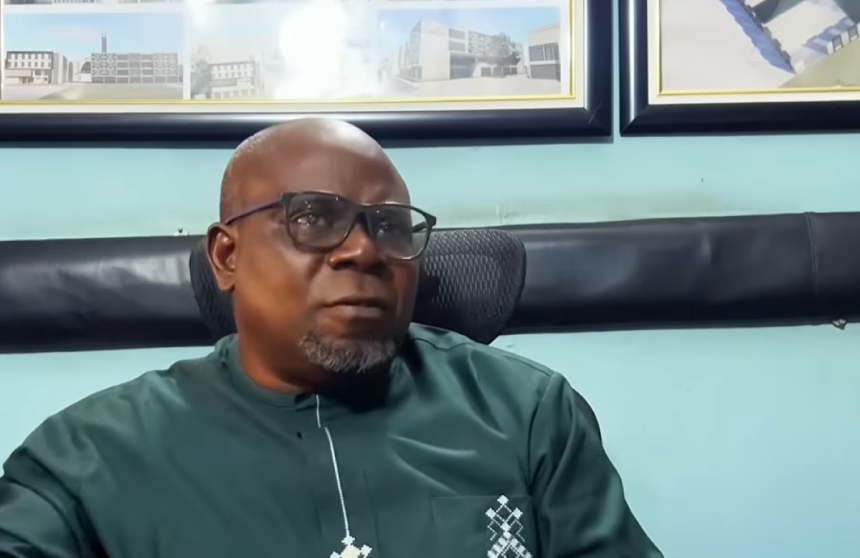
“I did not allow my own children to go to school.”
Say that sentence out loud in any Nigerian household and watch the reaction. Grades. Uniforms. WAEC. That’s the blueprint everyone follows, no questions asked. One father broke it completely — and what he built instead is now quietly challenging everything we assume “proper” education has to look like.
The Decision Everyone Called Madness
For most Nigerian parents, sending a child to school isn’t a decision — it’s an assumption baked in from birth. So when this father chose to keep all five of his children out of primary and secondary school entirely, teaching them himself inside his own home, the reaction from friends and family was swift and brutal: Is this man running mad? What are you trying to prove? Are you not shortchanging your own children?
His answer was simple, and it cuts to the heart of a conversation Nigeria hasn’t fully had yet: education, as it’s currently structured, is a misnomer. Studying political science doesn’t mean you must die a political scientist. School, as most of us know it, has become obsessed with grades — A1s, first-class degrees, distinctions — while quietly failing to teach the one thing that actually matters: how to think, create, and stand on your own.


He didn’t need to convince the Ministry of Education. He needed to control the one institution he already had full authority over — his own home. So his bedroom became a classroom. The family parlor became a lecture hall. The dining room doubled as everything else. That was the entire infrastructure behind five children who would go on to outperform peers from international schools.
What “Real” Education Looked Like Inside His Parlor
This wasn’t casual homeschooling. It was intentional, structured, and relentless. One son had completed over 100 certifications before he even sat his first university exam. Three of his children, while still in secondary school age, had already secured remote jobs with companies in the US and UK — one of them working in a Nigerian office by day and completing international remote contracts by night, all before setting foot on a university campus.
His last child, before entering university, spent three to four years at home mastering something even more striking: she now speaks four to five languages fluently, including Chinese, Arabic, English, and Korean — and has fully memorized the Quran.
None of this happened by accident. The father was deliberate about avoiding a specific kind of failure he saw everywhere in mainstream schooling: children graduating with strong grades but no clue how to generate value for themselves. He estimates that over 90% of Nigerian graduates are waiting on government jobs that may never come — a direct consequence of an education system built to produce certificates, not capability.
There’s a business lesson embedded in his method too. Inside his school, students run and operate their own business center — buying goods from the market, selling snacks and drinks to fellow students, and being graded on the profit they generate and how well they market what they sell. Entrepreneurship, negotiation, and money management, taught not as theory in a textbook, but as lived practice with real consequences.
When the Critics Became Believers
The turning point didn’t come from a policy change or a certificate of approval. It came from the results. Years after the homeschooling began, some of the same people who questioned his sanity started quietly monitoring the children — not the father, the children — to see what they were actually learning and how they were turning out.
One of them eventually returned with a confession that says everything: “We thought you were mad when you started all of this. But we are seeing the results of your madness — and our own children, even in international schools, are not doing as much as yours.” That same man went on to ask if the “madness” could be extended to his own daughter.
Eventually, even the government took notice. What started as an unapproved home-based education model was formally recognized by the state government — a rare instance of grassroots results forcing institutional validation, rather than the other way around.
Why This Matters for Nigeria Right Now
This isn’t an argument that every parent should pull their children out of school tomorrow. It’s a challenge to a deeper assumption: that a signboard, a uniform, and a syllabus automatically equal a good education. In a country where thousands of graduates leave university every year — many with strong results — and still have no clear path to earning a living, this father’s approach forces an uncomfortable but necessary question: what exactly are we optimizing for?
His answer was clear from the start. Not population. Not investment. Not a business. Just impact — deep, deliberate, and personal, achieved by controlling the one variable he could actually control: how his own children spent their formative years.
Why This Matters
- Challenges the assumption that formal schooling automatically equals quality education
- Highlights a real, lived alternative model producing measurable results
- Surfaces Nigeria’s graduate unemployment crisis as a systemic education problem, not just an economic one
- Shows how entrepreneurship and practical skills can be embedded directly into a child’s upbringing
- Demonstrates that unconventional parenting choices can eventually earn institutional recognition when results speak loudly enough
Join the Conversation
Would you ever consider homeschooling your children the way this father did? Drop a comment and tell us — are our schools really preparing children for life, or just for exams? Let’s hear where you stand.
Disclaimer: This article is adapted and edited from third-party YouTube video content for editorial and informational purposes. Personal experiences, claims, and details referenced belong to the original individuals featured in the source video and have not been independently verified by NaijaSphere. [Source: YouTube — kopa.respect TV, “I Refused to Send My 5 Children to School — I Taught Them Myself,” ]. This piece reflects one family’s personal experience and is not an endorsement of any specific educational approach; readers considering homeschooling should research their own state’s legal requirements and educational standards